Source @thailand_news
The logic is simple. The safest level crossing is the one that no longer exists. Thailand’s quiet statistics
projects have been completed in Tokyo, removing 395 railway crossings to date. Across Japan, the total number of level crossings has been cut roughly in half over 50 years.
The Japanese even have a special term, akazu no fumikiri, for crossings so heavily trafficked that they rarely open to road users. These get prioritised for elimination, either by elevating the railway onto viaducts or burying it underground.
Singapore: chose the most aggressive solution available. Its MRT runs entirely on elevated tracks or underground. Even the legacy KTM intercity line from Malaysia was decommissioned and replaced with a tunnelled route. There are essentially no urban level crossings left.
Hong Kong and Taiwan: in their dense urban cores, rail is grade-separated. Where at-grade crossings exist in suburban or rural zones, they are heavily fortified with full automatic barriers, multiple warning lights, and audible alarms.
https://thethaiger.com/wp-content/uploads/2026/05/Thailand_Train_Crash_26136360883850-820x546.jpg
United States: federal highway policy is blunt on the matter. The first alternative that should always be considered for a road-rail crossing is elimination. Elimination provides the highest level of crossing safety because the point of intersection is remove.
The logic is simple. The safest level crossing is the one that no longer exists. Thailand’s quiet statistics
This is not a problem the Thai authorities are unaware of. Thailand has 2,457 road-railway crossings across its 4,346-kilometre rail network. Only 410 of them have manned or automatic barriers. Another 144 are bridges and 117 are underpasses. Almost 1,800 crossings have no barriers at all.
The pattern of accidents tells the same story. Of 437 train-related incidents between 2005 and 2021, around 44 percent occurred at unofficial crossings.
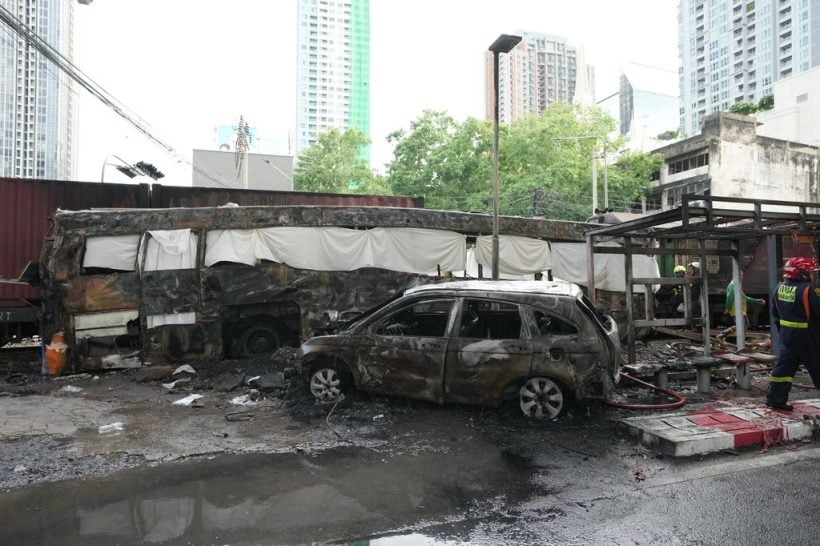
And this is not the first time a Thai freight train has obliterated a passenger bus. In 2020, a train hit a bus at a crossing in Chachoengsao, leaving 19 dead and 40 injured. It was one of the worst level crossing accidents in recent years.Saturday’s tragedy was a re-run of that disaster, scaled down only by chance.
A central reason nothing changes is that no single agency owns the problem. SRT has cited a 1963 rule to argue that it is only responsible for barriers at crossings where roads existed before the railway. Where the railway came first and the road followed, the responsibility falls to local or central road authorities
It is the classic Thai bureaucratic deadlock. Each agency points at the next. Budgets get bounced between ministries. Decades pass. And the rail network keeps cutting through neighbourhoods that have grown up around it.
https://thethaiger.com/wp-content/uploads/2026/05/Thailand_Train_Crash_26136369178326-820x546.jpg What can be done now?
Grade separation, burying the rail line or putting it on a viaduct through central Bangkok, is the only permanent answer. It would cost tens of billions of baht and take a decade. But it is not the only thing that can be done.
Before the first shovel hits the ground, several interventions are immediately possible.
Paint yellow box junctions across every at-grade rail crossing in Bangkok, with CCTV enforcement and automatic fines. Install signal pre-emption so that road traffic lights coordinate with train movements, a technology that has existed since the 1980s. Install crossing-occupancy sensors that detect vehicles stuck on the tracks and alert drivers in real time. Mandate that BMTA buses, taxis, and goods vehicles never enter a rail crossing without confirming a clear exit.
These are not moonshots. They are basic safety hygiene.
The uncomfortable truth
Bangkok is positioning itself as a regional high-speed rail hub. The Chinese-backed Bangkok-Nong Khai line is under construction. Double-tracking projects are spreading nationwide. The country is investing tens of billions of baht in rail.
Yet at the symbolic heart of Sukhumvit, an old freight [...]
← Back to newsThe Japanese even have a special term, akazu no fumikiri, for crossings so heavily trafficked that they rarely open to road users. These get prioritised for elimination, either by elevating the railway onto viaducts or burying it underground.
Singapore: chose the most aggressive solution available. Its MRT runs entirely on elevated tracks or underground. Even the legacy KTM intercity line from Malaysia was decommissioned and replaced with a tunnelled route. There are essentially no urban level crossings left.
Hong Kong and Taiwan: in their dense urban cores, rail is grade-separated. Where at-grade crossings exist in suburban or rural zones, they are heavily fortified with full automatic barriers, multiple warning lights, and audible alarms.
https://thethaiger.com/wp-content/uploads/2026/05/Thailand_Train_Crash_26136360883850-820x546.jpg
United States: federal highway policy is blunt on the matter. The first alternative that should always be considered for a road-rail crossing is elimination. Elimination provides the highest level of crossing safety because the point of intersection is remove.
The logic is simple. The safest level crossing is the one that no longer exists. Thailand’s quiet statistics
This is not a problem the Thai authorities are unaware of. Thailand has 2,457 road-railway crossings across its 4,346-kilometre rail network. Only 410 of them have manned or automatic barriers. Another 144 are bridges and 117 are underpasses. Almost 1,800 crossings have no barriers at all.
The pattern of accidents tells the same story. Of 437 train-related incidents between 2005 and 2021, around 44 percent occurred at unofficial crossings.
And this is not the first time a Thai freight train has obliterated a passenger bus. In 2020, a train hit a bus at a crossing in Chachoengsao, leaving 19 dead and 40 injured. It was one of the worst level crossing accidents in recent years.Saturday’s tragedy was a re-run of that disaster, scaled down only by chance.
A central reason nothing changes is that no single agency owns the problem. SRT has cited a 1963 rule to argue that it is only responsible for barriers at crossings where roads existed before the railway. Where the railway came first and the road followed, the responsibility falls to local or central road authorities
It is the classic Thai bureaucratic deadlock. Each agency points at the next. Budgets get bounced between ministries. Decades pass. And the rail network keeps cutting through neighbourhoods that have grown up around it.
https://thethaiger.com/wp-content/uploads/2026/05/Thailand_Train_Crash_26136369178326-820x546.jpg What can be done now?
Grade separation, burying the rail line or putting it on a viaduct through central Bangkok, is the only permanent answer. It would cost tens of billions of baht and take a decade. But it is not the only thing that can be done.
Before the first shovel hits the ground, several interventions are immediately possible.
Paint yellow box junctions across every at-grade rail crossing in Bangkok, with CCTV enforcement and automatic fines. Install signal pre-emption so that road traffic lights coordinate with train movements, a technology that has existed since the 1980s. Install crossing-occupancy sensors that detect vehicles stuck on the tracks and alert drivers in real time. Mandate that BMTA buses, taxis, and goods vehicles never enter a rail crossing without confirming a clear exit.
These are not moonshots. They are basic safety hygiene.
The uncomfortable truth
Bangkok is positioning itself as a regional high-speed rail hub. The Chinese-backed Bangkok-Nong Khai line is under construction. Double-tracking projects are spreading nationwide. The country is investing tens of billions of baht in rail.
Yet at the symbolic heart of Sukhumvit, an old freight [...]