Source @thailand_news
Safety failures, not misfortune, caused crane collapse that killed 31
Safety failures, not misfortune, caused crane collapse that killed 31
https://thethaiger.com/wp-content/uploads/2026/05/thailand-train-crash-1.jpg Safety failures, not misfortune, caused crane collapse that killed 31Legacyhttps://thethaiger.com/wp-content/uploads/2026/05/thailand-train-crash-1.jpg
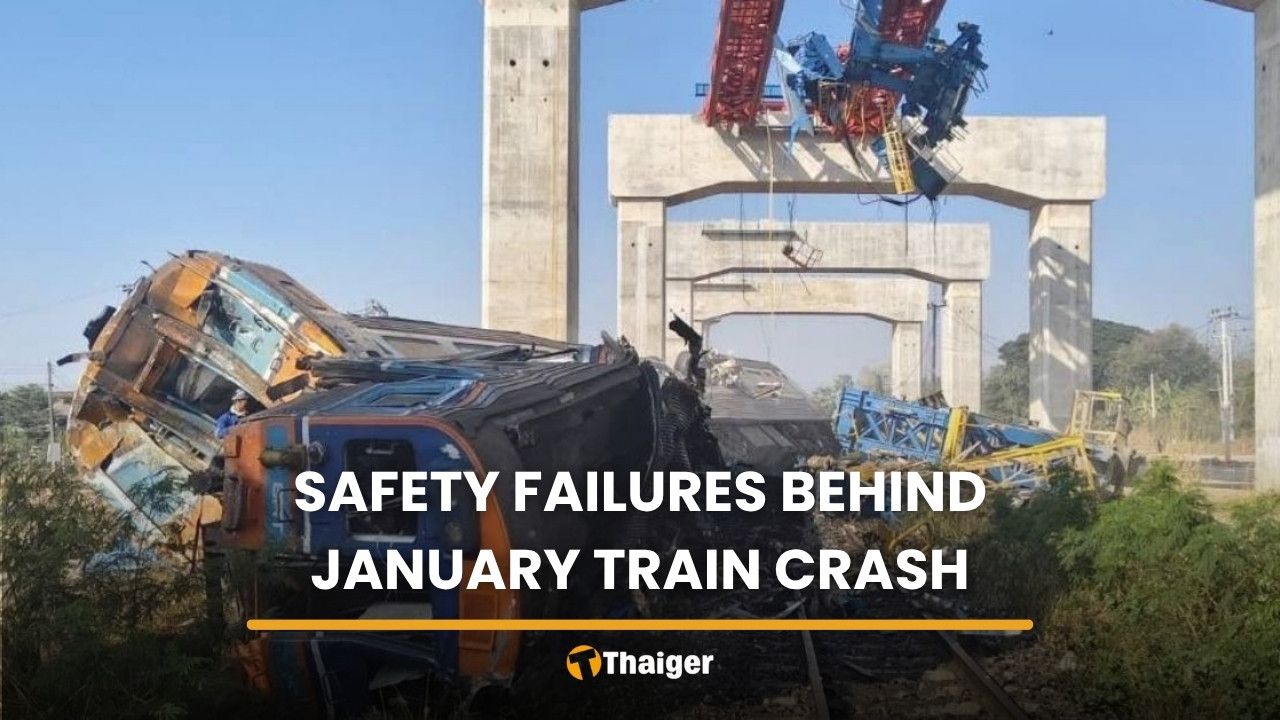
A construction crane collapse, causing a train crash in Thailand that killed 31, has been ruled the result of procedural violations and safety failures rather than an unavoidable accident, according to findings released by a government fact-finding committee on May 26.
Thirty-one people died when equipment from a high-speed rail construction site fell onto Express Train No. 21, operating between Krung Thep Aphiwat Central Terminal and Ubon Ratchathani, at 9.15am on January 14, between Nong Nam Khun and Si Khio stations in Nakhon Ratchasima province.
The findings were presented jointly by Jirapong Theppithak, Deputy Permanent Secretary of the Ministry of Transport and chairman of the fact-finding committee, alongside Piyapong Jiwatthanakun Phokkun, Director-General of the Department of Highways, and Anan Photnimdaeng, acting governor of the State Railway of Thailand (SRT).
Jirapong said the committee conducted a 45-day investigation that included site inspections, destructive and non-destructive materials testing, electron microscope analysis of metal components, structural collapse modelling, and interviews with all relevant parties, including the contractor, construction supervisor, project owner, and railway station staff.
https://thethaiger.com/wp-content/uploads/2026/05/thailand-train-crash-2.jpg Fact-finding committee announces the investigation results | Photo via Amarin Investigation findings
The committee determined that the accident resulted from a combination of failures in operational procedure, safety controls, and site supervision. The launching gantry, a large crane used to lift and install precast concrete segments, was operated in breach of engineering procedures and safety requirements on the day of the incident.
The front support point was overloaded as a result, causing structural failure and the collapse of the equipment onto the active rail line as the train passed.
Specific lapses identified by the committee included failure to obtain a formal window time authorisation to suspend train operations before work began, work being carried out prior to official approval, and equipment inspections that fell outside the required schedule.
On-site supervision was also found to be inconsistent with the standards required under the project’s guidelines.
The committee recommended strengthening the oversight system for construction projects within active rail corridors, including deploying an appropriate number of engineering personnel, increasing the rigour of on-site monitoring, and improving joint safety inspection mechanisms with external agencies.
https://thethaiger.com/wp-content/uploads/2026/05/thailand-train-crash-3.jpg Scene of the crane collapse | Photo via Facebook/ กรมป้องกันและบรรเทาสาธารณภัย DDPM
Anan confirmed that the SRT’s own investigation board had submitted its findings to the Ministry of Transport, and that contractual and legal processes in relation to those findings were underway. Construction work on the project was continuing under tightened supervision and safety controls, he said. Safety measures announced
The SRT announced a series of measures to be implemented across all projects nationwide. All work near railway boundaries will require written window time authorisation from the SRT before any activity on overhead structures can begin.
The existing system of advance and retrospective work approvals will be abolished, replaced by daily approvals from the construction supervision consultant, supported by photographic evidence taken on site before sign-off.
Engine[...]
← Back to newshttps://thethaiger.com/wp-content/uploads/2026/05/thailand-train-crash-1.jpg Safety failures, not misfortune, caused crane collapse that killed 31Legacyhttps://thethaiger.com/wp-content/uploads/2026/05/thailand-train-crash-1.jpg
A construction crane collapse, causing a train crash in Thailand that killed 31, has been ruled the result of procedural violations and safety failures rather than an unavoidable accident, according to findings released by a government fact-finding committee on May 26.
Thirty-one people died when equipment from a high-speed rail construction site fell onto Express Train No. 21, operating between Krung Thep Aphiwat Central Terminal and Ubon Ratchathani, at 9.15am on January 14, between Nong Nam Khun and Si Khio stations in Nakhon Ratchasima province.
The findings were presented jointly by Jirapong Theppithak, Deputy Permanent Secretary of the Ministry of Transport and chairman of the fact-finding committee, alongside Piyapong Jiwatthanakun Phokkun, Director-General of the Department of Highways, and Anan Photnimdaeng, acting governor of the State Railway of Thailand (SRT).
Jirapong said the committee conducted a 45-day investigation that included site inspections, destructive and non-destructive materials testing, electron microscope analysis of metal components, structural collapse modelling, and interviews with all relevant parties, including the contractor, construction supervisor, project owner, and railway station staff.
https://thethaiger.com/wp-content/uploads/2026/05/thailand-train-crash-2.jpg Fact-finding committee announces the investigation results | Photo via Amarin Investigation findings
The committee determined that the accident resulted from a combination of failures in operational procedure, safety controls, and site supervision. The launching gantry, a large crane used to lift and install precast concrete segments, was operated in breach of engineering procedures and safety requirements on the day of the incident.
The front support point was overloaded as a result, causing structural failure and the collapse of the equipment onto the active rail line as the train passed.
Specific lapses identified by the committee included failure to obtain a formal window time authorisation to suspend train operations before work began, work being carried out prior to official approval, and equipment inspections that fell outside the required schedule.
On-site supervision was also found to be inconsistent with the standards required under the project’s guidelines.
The committee recommended strengthening the oversight system for construction projects within active rail corridors, including deploying an appropriate number of engineering personnel, increasing the rigour of on-site monitoring, and improving joint safety inspection mechanisms with external agencies.
https://thethaiger.com/wp-content/uploads/2026/05/thailand-train-crash-3.jpg Scene of the crane collapse | Photo via Facebook/ กรมป้องกันและบรรเทาสาธารณภัย DDPM
Anan confirmed that the SRT’s own investigation board had submitted its findings to the Ministry of Transport, and that contractual and legal processes in relation to those findings were underway. Construction work on the project was continuing under tightened supervision and safety controls, he said. Safety measures announced
The SRT announced a series of measures to be implemented across all projects nationwide. All work near railway boundaries will require written window time authorisation from the SRT before any activity on overhead structures can begin.
The existing system of advance and retrospective work approvals will be abolished, replaced by daily approvals from the construction supervision consultant, supported by photographic evidence taken on site before sign-off.
Engine[...]