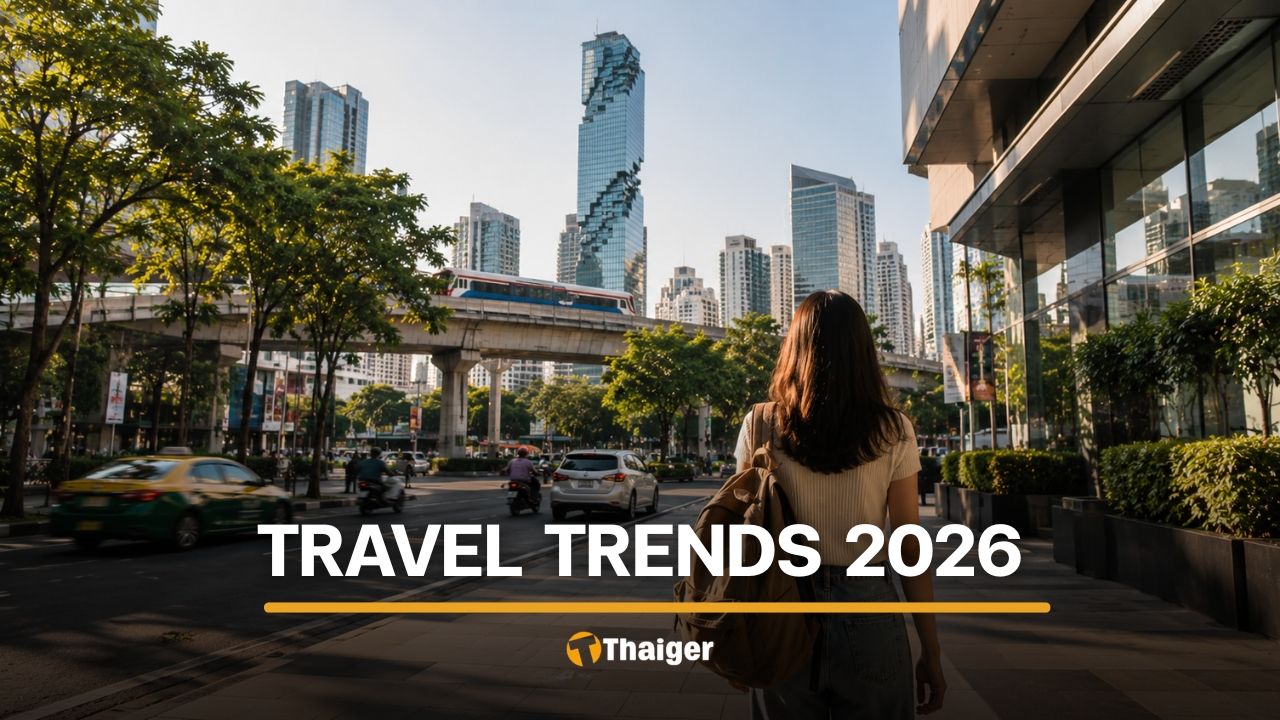
Source @thailand_news
The travel trends of 2026, and what it means if you are heading to Thailand
The travel trends of 2026, and what it means if you are heading to Thailand
https://thethaiger.com/wp-content/uploads/2026/05/สำเนาของ-23-34-53.jpg The travel trends of 2026, and what it means if you are heading to ThailandLegacyhttps://thethaiger.com/wp-content/uploads/2026/05/สำเนาของ-23-34-53.jpg
Every year produces a new set of travel trend reports, and most of them say roughly the same thing. The 2026 edition from Hilton, built on a survey of over 14,000 travellers across 14 countries conducted by Ipsos, is different in one important respect: its findings align almost point for point with what Thailand already does well. The five trends the report identifies, intentional travel, the search for silence, the pull of home comforts on the road, multi-generational family holidays, and inherited travel habits, describe a destination Thailand has been building toward for years without necessarily calling it a trend.
On this page
Section (Click to jump) summary The ‘whycation’ — travelling with a reason Travellers are increasingly planning trips around rest, nature, and mental wellbeing, which aligns closely with Thailand’s wellness strengths. Hushpitality — the growing appetite for quiet Quiet, calm, and solo-friendly travel is growing, and Thailand already offers retreats, temples, parks, and slower spaces that support it. Home comforts as the new carry-on Travellers want familiar routines, pet-friendly stays, comfort food, and grocery browsing, all of which Thailand supports well. Generation permutations — the expanded family holiday Thailand is well placed for multi-generational trips thanks to family-friendly resorts, shared activities, and strong hospitality infrastructure. Inheritourism — travel habits passed down through the generations Thailand benefits from decades of repeat visitors whose travel habits are now being passed on to younger generations. 1. The ‘whycation’ — travelling with a reason
The headline finding from the report is what Hilton calls the “whycation”: the shift from planning a holiday around a destination to planning it around a motivation. The number one reason people said they would travel in 2026 is to rest and recharge, cited by 56% of respondents. Spending time in nature came second at 37%, followed by improving mental health at 36%.
This is precisely the lane Thailand’s Tourism Authority has moved into for 2026. The TAT’s current campaign, “Healing is the New Luxury,” positions Thailand around rest, restoration, and intentional experience rather than sightseeing volume. The framing is not coincidental. Thailand’s wellness tourism market reached US$14 billion in 2024, up 36.4% year on year, according to the Global Wellness Institute, making it one of the fastest-growing wellness destinations in the world.
https://thethaiger.com/wp-content/uploads/2026/05/Featured-Image-Template-16-1.jpg Chiva-Som in Hia Hin | Photo taken Chiva-Som’s website
The country has 61 JCI-accredited hospitals, 92,813 wellness-related businesses, and a retreat sector, from Chiva-Som in Hua Hin to Kamalaya on Koh Samui to RAKxa near Bangkok, that has been running dedicated burnout, sleep, and mental health programmes for decades.
For expats already living here, the infrastructure for a domestic whycation is well within reach. For visitors planning a longer trip, Thailand offers the unusual combination of world-class wellness facilities at prices that remain significantly below comparable destinations in Europe or the Maldives. 2. Hushpitality — the growing appetite for quiet
Closely related to the whycation is what the Hilton report calls hushpitality: the active pursuit of silence, calm, and the absence of stimulation. More than a quarter of travellers said they plan to seek out quiet moments even within group trips in 2026. Solo travel is rising sharply, with Bangkok ranking as the second most popular solo city in Asia, according[...]
← Back to newshttps://thethaiger.com/wp-content/uploads/2026/05/สำเนาของ-23-34-53.jpg The travel trends of 2026, and what it means if you are heading to ThailandLegacyhttps://thethaiger.com/wp-content/uploads/2026/05/สำเนาของ-23-34-53.jpg
Every year produces a new set of travel trend reports, and most of them say roughly the same thing. The 2026 edition from Hilton, built on a survey of over 14,000 travellers across 14 countries conducted by Ipsos, is different in one important respect: its findings align almost point for point with what Thailand already does well. The five trends the report identifies, intentional travel, the search for silence, the pull of home comforts on the road, multi-generational family holidays, and inherited travel habits, describe a destination Thailand has been building toward for years without necessarily calling it a trend.
On this page
Section (Click to jump) summary The ‘whycation’ — travelling with a reason Travellers are increasingly planning trips around rest, nature, and mental wellbeing, which aligns closely with Thailand’s wellness strengths. Hushpitality — the growing appetite for quiet Quiet, calm, and solo-friendly travel is growing, and Thailand already offers retreats, temples, parks, and slower spaces that support it. Home comforts as the new carry-on Travellers want familiar routines, pet-friendly stays, comfort food, and grocery browsing, all of which Thailand supports well. Generation permutations — the expanded family holiday Thailand is well placed for multi-generational trips thanks to family-friendly resorts, shared activities, and strong hospitality infrastructure. Inheritourism — travel habits passed down through the generations Thailand benefits from decades of repeat visitors whose travel habits are now being passed on to younger generations. 1. The ‘whycation’ — travelling with a reason
The headline finding from the report is what Hilton calls the “whycation”: the shift from planning a holiday around a destination to planning it around a motivation. The number one reason people said they would travel in 2026 is to rest and recharge, cited by 56% of respondents. Spending time in nature came second at 37%, followed by improving mental health at 36%.
This is precisely the lane Thailand’s Tourism Authority has moved into for 2026. The TAT’s current campaign, “Healing is the New Luxury,” positions Thailand around rest, restoration, and intentional experience rather than sightseeing volume. The framing is not coincidental. Thailand’s wellness tourism market reached US$14 billion in 2024, up 36.4% year on year, according to the Global Wellness Institute, making it one of the fastest-growing wellness destinations in the world.
https://thethaiger.com/wp-content/uploads/2026/05/Featured-Image-Template-16-1.jpg Chiva-Som in Hia Hin | Photo taken Chiva-Som’s website
The country has 61 JCI-accredited hospitals, 92,813 wellness-related businesses, and a retreat sector, from Chiva-Som in Hua Hin to Kamalaya on Koh Samui to RAKxa near Bangkok, that has been running dedicated burnout, sleep, and mental health programmes for decades.
For expats already living here, the infrastructure for a domestic whycation is well within reach. For visitors planning a longer trip, Thailand offers the unusual combination of world-class wellness facilities at prices that remain significantly below comparable destinations in Europe or the Maldives. 2. Hushpitality — the growing appetite for quiet
Closely related to the whycation is what the Hilton report calls hushpitality: the active pursuit of silence, calm, and the absence of stimulation. More than a quarter of travellers said they plan to seek out quiet moments even within group trips in 2026. Solo travel is rising sharply, with Bangkok ranking as the second most popular solo city in Asia, according[...]