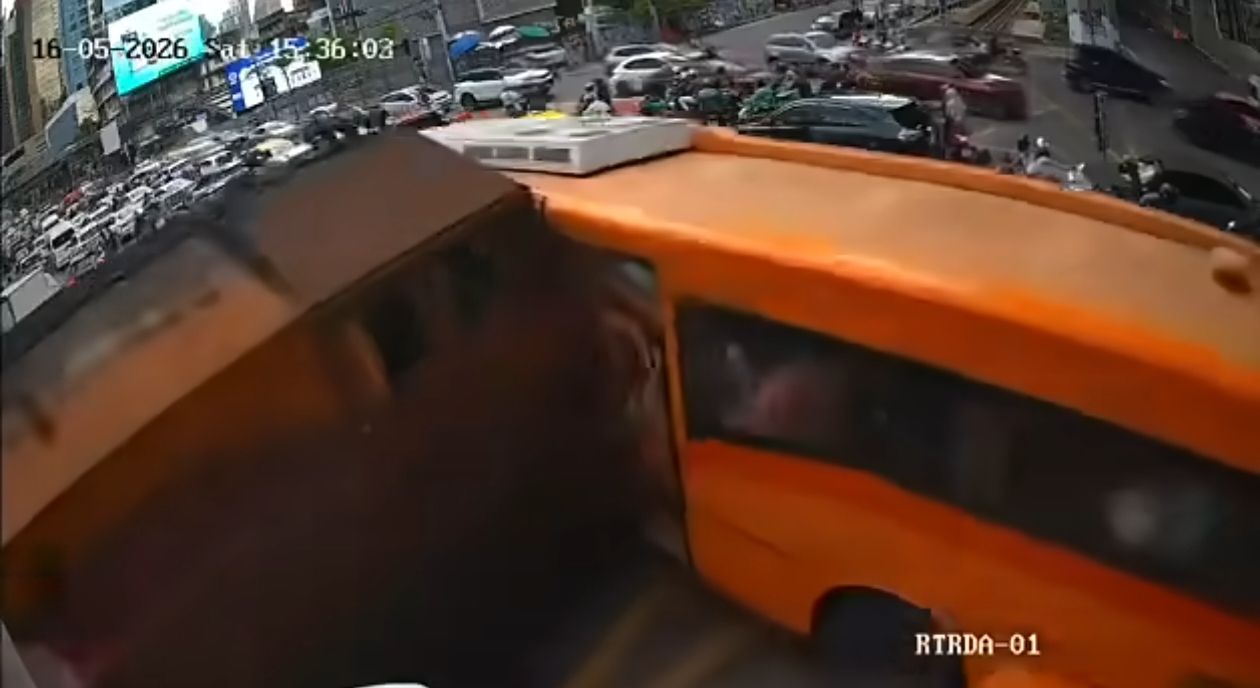
Source @thailand_news
Train-bus collision Bangkok’s Makkasan was not an accident. It was a system designed to fail
Train-bus collision Bangkok’s Makkasan was not an accident. It was a system designed to fail
https://thethaiger.com/wp-content/uploads/2026/05/IMG_20260516_204132.jpg Train-bus collision Bangkok’s Makkasan was not an accident. It was a system designed to failLegacyhttps://thethaiger.com/wp-content/uploads/2026/05/IMG_20260516_204132.jpg
[OPINION] Bangkok’s Makkasan train-bus collision was not an accident. It was a system designed to fail
A freight train rumbles across a major commercial intersection at street level, while buses and cars sit waiting at a red light straddling the tracks.
It sounds absurd. In most global cities, it would be. In Bangkok, on the afternoon of Saturday 16 May 2026, it was reality. And it cost at least eight people their lives.
A State Railway of Thailand freight train, en route from Chachoengsao to Bang Sue, struck a Bangkok Mass Transit Authority (BMTA) route 206 air-conditioned bus that had become stranded on the tracks beneath the Asoke-Phetchaburi expressway. The collision triggered a fireball that engulfed nearby motorbikes and cars. Twenty-five people were injured. Some estimates put the figure higher.
The official cause? The bus was caught at a red light, stuck straddling the railway tracks because of heavy traffic ahead.
It is tempting to file this under “freak accident”. It is not. A 20th-century crossing in a 21st-century megacity
The first and largest failure here is not who did what, but why this crossing exists at all.
Asoke Halt is a minor stop on the SRT’s Eastern Line, sitting in one of Asia’s most expensive commercial districts, within walking distance of MRT Phetchaburi, the Airport Rail Link’s Makkasan terminus, and Sukhumvit’s luxury hotels and embassies.
Every time a train runs between Bang Sue and the eastern seaboard, hauling either passengers or freight from Laem Chabang port, it cuts directly through this neighbourhood at ground level. Through traffic. Through tens of thousands of pedestrians a day. Past five-star hotels.
The international comparison is uncomfortable. Tokyo, Singapore, Hong Kong, Taipei, Seoul: none of them route freight trains through their central business district at street level. They stopped doing so decades ago, in some cases more than a century ago.
https://thethaiger.com/wp-content/uploads/2026/05/Thailand_Train_Crash_26136378121328-820x546.jpg A cascade of failures, not one
In modern urban rail systems, for a vehicle to even reach the position the route 206 bus found itself in, three separate safety layers must fail in sequence.
1. Barriers and signalling. A witness who filmed the moments before impact claimed the level crossing barriers never came down. If true, the most basic line of defence simply did not function.
2. Traffic signal pre-emption. In cities with modern crossing systems, the red light facing the road is timed against incoming train movements. When a train approaches, the light immediately stops traffic from entering the danger zone, regardless of the normal cycle. Bangkok’s traffic lights and SRT’s signals do not appear to talk to each other in any meaningful way.
3. Yellow box junctions. Painted markings, enforced by camera or fine, that prohibit drivers from entering a crossing if there is no clear exit on the other side. Standard in London, Hong Kong, and most European capitals. Largely absent from Bangkok’s at-grade rail crossings.
All three layers failed, or were never properly there to begin with.
https://thethaiger.com/wp-content/uploads/2026/05/IMG_20260516_223542-624x820.jpg What other cities did about this?
Cities that once had Bangkok’s problem made a choice, sometimes painful, sometimes expensive, but always decisive.
Japan: Tokyo’s metropolitan government has spent decades systematically eliminating level crossings. Forty-three separate[...]
← Back to newshttps://thethaiger.com/wp-content/uploads/2026/05/IMG_20260516_204132.jpg Train-bus collision Bangkok’s Makkasan was not an accident. It was a system designed to failLegacyhttps://thethaiger.com/wp-content/uploads/2026/05/IMG_20260516_204132.jpg
[OPINION] Bangkok’s Makkasan train-bus collision was not an accident. It was a system designed to fail
A freight train rumbles across a major commercial intersection at street level, while buses and cars sit waiting at a red light straddling the tracks.
It sounds absurd. In most global cities, it would be. In Bangkok, on the afternoon of Saturday 16 May 2026, it was reality. And it cost at least eight people their lives.
A State Railway of Thailand freight train, en route from Chachoengsao to Bang Sue, struck a Bangkok Mass Transit Authority (BMTA) route 206 air-conditioned bus that had become stranded on the tracks beneath the Asoke-Phetchaburi expressway. The collision triggered a fireball that engulfed nearby motorbikes and cars. Twenty-five people were injured. Some estimates put the figure higher.
The official cause? The bus was caught at a red light, stuck straddling the railway tracks because of heavy traffic ahead.
It is tempting to file this under “freak accident”. It is not. A 20th-century crossing in a 21st-century megacity
The first and largest failure here is not who did what, but why this crossing exists at all.
Asoke Halt is a minor stop on the SRT’s Eastern Line, sitting in one of Asia’s most expensive commercial districts, within walking distance of MRT Phetchaburi, the Airport Rail Link’s Makkasan terminus, and Sukhumvit’s luxury hotels and embassies.
Every time a train runs between Bang Sue and the eastern seaboard, hauling either passengers or freight from Laem Chabang port, it cuts directly through this neighbourhood at ground level. Through traffic. Through tens of thousands of pedestrians a day. Past five-star hotels.
The international comparison is uncomfortable. Tokyo, Singapore, Hong Kong, Taipei, Seoul: none of them route freight trains through their central business district at street level. They stopped doing so decades ago, in some cases more than a century ago.
https://thethaiger.com/wp-content/uploads/2026/05/Thailand_Train_Crash_26136378121328-820x546.jpg A cascade of failures, not one
In modern urban rail systems, for a vehicle to even reach the position the route 206 bus found itself in, three separate safety layers must fail in sequence.
1. Barriers and signalling. A witness who filmed the moments before impact claimed the level crossing barriers never came down. If true, the most basic line of defence simply did not function.
2. Traffic signal pre-emption. In cities with modern crossing systems, the red light facing the road is timed against incoming train movements. When a train approaches, the light immediately stops traffic from entering the danger zone, regardless of the normal cycle. Bangkok’s traffic lights and SRT’s signals do not appear to talk to each other in any meaningful way.
3. Yellow box junctions. Painted markings, enforced by camera or fine, that prohibit drivers from entering a crossing if there is no clear exit on the other side. Standard in London, Hong Kong, and most European capitals. Largely absent from Bangkok’s at-grade rail crossings.
All three layers failed, or were never properly there to begin with.
https://thethaiger.com/wp-content/uploads/2026/05/IMG_20260516_223542-624x820.jpg What other cities did about this?
Cities that once had Bangkok’s problem made a choice, sometimes painful, sometimes expensive, but always decisive.
Japan: Tokyo’s metropolitan government has spent decades systematically eliminating level crossings. Forty-three separate[...]