Source @thailand_news
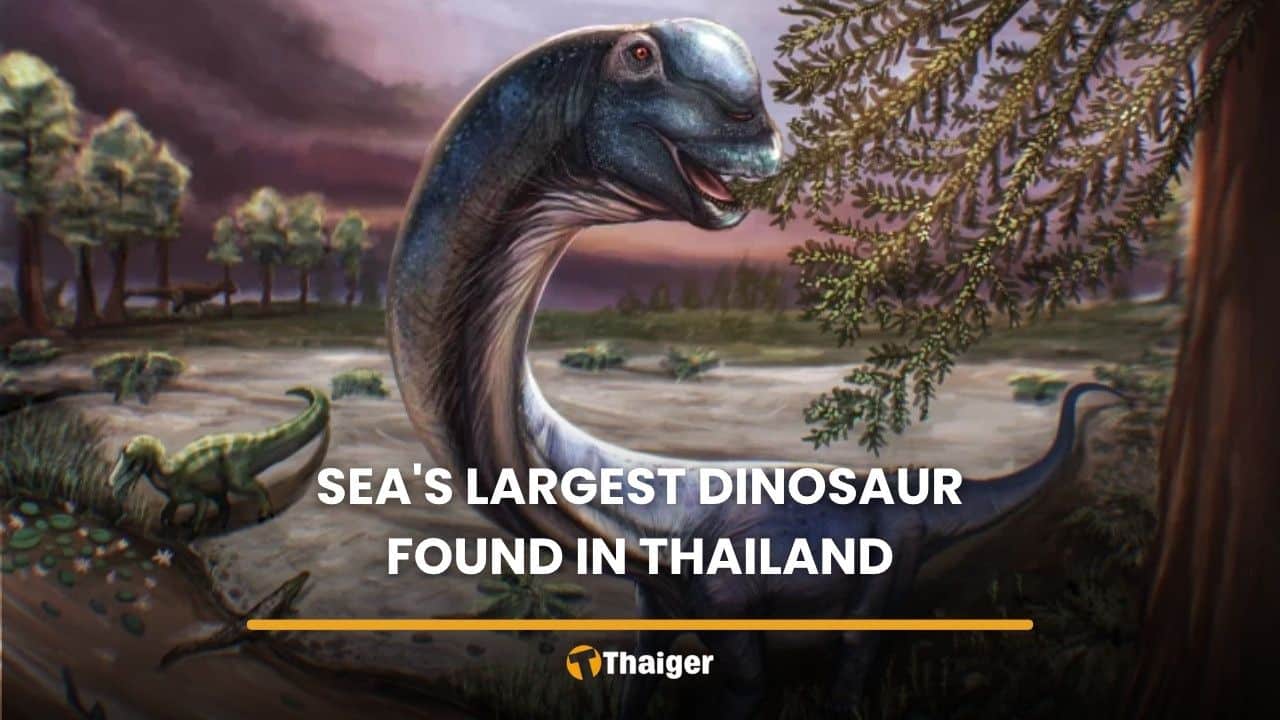
Thailand’s ‘last titan’ confirmed as Southeast Asia’s biggest dinosaur on record
Thailand’s ‘last titan’ confirmed as Southeast Asia’s biggest dinosaur on record
https://thethaiger.com/wp-content/uploads/2026/05/dinosaur.jpg Thailand’s ‘last titan’ confirmed as Southeast Asia’s biggest dinosaur on recordLegacyhttps://thethaiger.com/wp-content/uploads/2026/05/dinosaur.jpg
Scientists have identified a new dinosaur species in Thailand, the largest ever found in Southeast Asia, after fossils unearthed beside a pond in Chaiyaphum province were confirmed as belonging to a colossal long-necked sauropod estimated to have measured 27 metres and weighed around 27 to 30 tonnes.
The species, named Nagatitan chaiyaphumensis, lived between 100 and 120 million years ago during the late Early Cretaceous period, roughly 40 million years before Tyrannosaurus rex (T-rex). The findings were published in the journal Scientific Reports.
The name combines “naga”, the mythological serpent of Southeast Asian folklore, “titan” in reference to its size, and “chaiyaphumensis” meaning “from Chaiyaphum”, the province where the fossils were found. Discovery and excavation
The bones were first spotted in 2016 by a local named Thanom Luangnan, who noticed what he described as unusual rocks on the banks of a public pond and reported the find to Thailand’s Department of Mineral Resources.
Initial excavation ran from 2016 to 2019 before funding lapsed. When the research team secured new funding, work resumed in 2024.
Researchers do not have a complete skeleton. Size estimates are based on spine, rib, pelvis, and leg bones recovered from the site, including a front leg bone measuring nearly six feet in length. The fossils are described as the most complete sauropod specimen yet discovered from the Khok Kruat Formation.
https://thethaiger.com/wp-content/uploads/2026/05/dinosaur-2.jpg Recovery of Nagatitan, the largest dinosaur ever discovered in Thailand | Photo: Tanintorn Ketburana via National Geographic The research team
The study was led by Thitiwoot Sethapanichsakul, a Thai doctoral student at University College London (UCL), alongside palaeontologist Sita Manitkoon from Mahasarakham University, who oversaw the recovery. Co-author Paul Upchurch, a palaeontologist at UCL, and Pedro Mocho of the Universidade de Lisboa also contributed analysis, with Mocho noting that until this discovery, large dinosaurs in Thailand had been known only from fragmentary remains.
Sethapanichsakul said the team referred to the Nagatitan as “the last titan” of Thailand. The dinosaur was found in the country’s youngest dinosaur-bearing rock formation, and because the region subsequently became a shallow sea, researchers say it is unlikely further large sauropods will be found in Southeast Asia.
The Nagatitan is the 14th dinosaur to be named in Thailand. Manitkoon said Thailand has high diversity in dinosaur fossils and is “possibly the third most abundant in Asia in terms of dinosaur remains.” Size and evolutionary significance
At an estimated 27 to 30 tonnes, the Nagatitan was heavier than nine adult Asian elephants and more than three times the weight of a T-rex, though it falls in the upper-middle range of the largest dinosaurs ever recorded. Sauropods from later in the Cretaceous period grew considerably larger, with some reaching an estimated 70 tonnes.
Nagatitan belonged to a group called the somphospondyli, characterised by long forelimbs relative to other sauropods and a wide stance. Researchers say the discovery represents an early stage in a broader trend towards gigantism among sauropods during the Cretaceous.
https://thethaiger.com/wp-content/uploads/2026/05/dinosaur-4.jpg A representation of the Nagatitan skeleton, with the bones researchers have found marked in yellow | Photo: Thitiwoot Sethapanichsakul et al. Climate and habitat
During the period Nagatitan lived, Thailand sat closer to the equator than it does today. Th[...]
← Back to newshttps://thethaiger.com/wp-content/uploads/2026/05/dinosaur.jpg Thailand’s ‘last titan’ confirmed as Southeast Asia’s biggest dinosaur on recordLegacyhttps://thethaiger.com/wp-content/uploads/2026/05/dinosaur.jpg
Scientists have identified a new dinosaur species in Thailand, the largest ever found in Southeast Asia, after fossils unearthed beside a pond in Chaiyaphum province were confirmed as belonging to a colossal long-necked sauropod estimated to have measured 27 metres and weighed around 27 to 30 tonnes.
The species, named Nagatitan chaiyaphumensis, lived between 100 and 120 million years ago during the late Early Cretaceous period, roughly 40 million years before Tyrannosaurus rex (T-rex). The findings were published in the journal Scientific Reports.
The name combines “naga”, the mythological serpent of Southeast Asian folklore, “titan” in reference to its size, and “chaiyaphumensis” meaning “from Chaiyaphum”, the province where the fossils were found. Discovery and excavation
The bones were first spotted in 2016 by a local named Thanom Luangnan, who noticed what he described as unusual rocks on the banks of a public pond and reported the find to Thailand’s Department of Mineral Resources.
Initial excavation ran from 2016 to 2019 before funding lapsed. When the research team secured new funding, work resumed in 2024.
Researchers do not have a complete skeleton. Size estimates are based on spine, rib, pelvis, and leg bones recovered from the site, including a front leg bone measuring nearly six feet in length. The fossils are described as the most complete sauropod specimen yet discovered from the Khok Kruat Formation.
https://thethaiger.com/wp-content/uploads/2026/05/dinosaur-2.jpg Recovery of Nagatitan, the largest dinosaur ever discovered in Thailand | Photo: Tanintorn Ketburana via National Geographic The research team
The study was led by Thitiwoot Sethapanichsakul, a Thai doctoral student at University College London (UCL), alongside palaeontologist Sita Manitkoon from Mahasarakham University, who oversaw the recovery. Co-author Paul Upchurch, a palaeontologist at UCL, and Pedro Mocho of the Universidade de Lisboa also contributed analysis, with Mocho noting that until this discovery, large dinosaurs in Thailand had been known only from fragmentary remains.
Sethapanichsakul said the team referred to the Nagatitan as “the last titan” of Thailand. The dinosaur was found in the country’s youngest dinosaur-bearing rock formation, and because the region subsequently became a shallow sea, researchers say it is unlikely further large sauropods will be found in Southeast Asia.
The Nagatitan is the 14th dinosaur to be named in Thailand. Manitkoon said Thailand has high diversity in dinosaur fossils and is “possibly the third most abundant in Asia in terms of dinosaur remains.” Size and evolutionary significance
At an estimated 27 to 30 tonnes, the Nagatitan was heavier than nine adult Asian elephants and more than three times the weight of a T-rex, though it falls in the upper-middle range of the largest dinosaurs ever recorded. Sauropods from later in the Cretaceous period grew considerably larger, with some reaching an estimated 70 tonnes.
Nagatitan belonged to a group called the somphospondyli, characterised by long forelimbs relative to other sauropods and a wide stance. Researchers say the discovery represents an early stage in a broader trend towards gigantism among sauropods during the Cretaceous.
https://thethaiger.com/wp-content/uploads/2026/05/dinosaur-4.jpg A representation of the Nagatitan skeleton, with the bones researchers have found marked in yellow | Photo: Thitiwoot Sethapanichsakul et al. Climate and habitat
During the period Nagatitan lived, Thailand sat closer to the equator than it does today. Th[...]