Source @thailand_news
Tell us where you land.
l discretionary. The nominee structure is still, for many of them, the only practical road, the same road that, in its property form, now ends in seizure. And on the business side this is no longer a distant threat. Since January 2026 the Department of Business Development has required new companies with foreign shareholders to produce three months of bank statements proving that their Thai shareholders’ money is genuinely their own, and from April it extended the same scrutiny to later changes in shareholding. The Commerce Ministry has said in plain terms that it will keep pursuing businesses that use Thai nominees to front for foreigners. The tool that the law left as the small operator’s only legal road is quietly being turned into the evidence against them.
Thai lawyers have put this more bluntly than we would dare. One senior partner noted that there has always been a fast, simple fix, the government can exempt service categories by ministerial regulation with a stroke of the pen, and added, on the record, that “the Thai government simply does not want to.” Others warn that past FBA reforms have a habit of lifting a restriction in one place only for another regulator to quietly reimpose it in another, leaving the foreigner exactly as boxed in as before, just by a different department. The scope of restricted activities, in the words of one Thai corporate counsel, remains vague, still exposing people to retrospective scrutiny and shifting interpretation. The gap between the rule on paper and the rule in practice, the thread running through this whole series, runs straight through the business story too. The same lesson, refusing to be learned twice
The parallel with property is almost exact. In property, Thailand tore down the legal route to ownership and left the nominee workaround standing, then started prosecuting the people who used it. In business, Thailand built a restriction that made the nominee workaround near-unavoidable for small operators, and is only now, partially, and only for the largest players, beginning to take it apart. Both run on the same broken machine: a rule so blunt it forces honest people into a grey structure, and a state that then treats the grey structure, rather than its own rule, as the crime.
And both point to the same fix, the one this series keeps circling and will land on at its end. You do not hunt the workaround into extinction with raids. You build a clean, legal road beside it, so clear and so durable that no sane person takes the dangerous detour anymore, and the grey structures empty out on their own, without a single prosecution. The business reform is, at last, a half-step onto exactly that road. It is the proof that Thailand understands the principle perfectly: lower the barrier, and the evasion you hated vanishes by itself. It has simply chosen to hand that understanding to the multinational with the treasury centre, and not yet to the designer with her studio, or the clinic, or the café, the people who quietly helped make the country worth moving to.
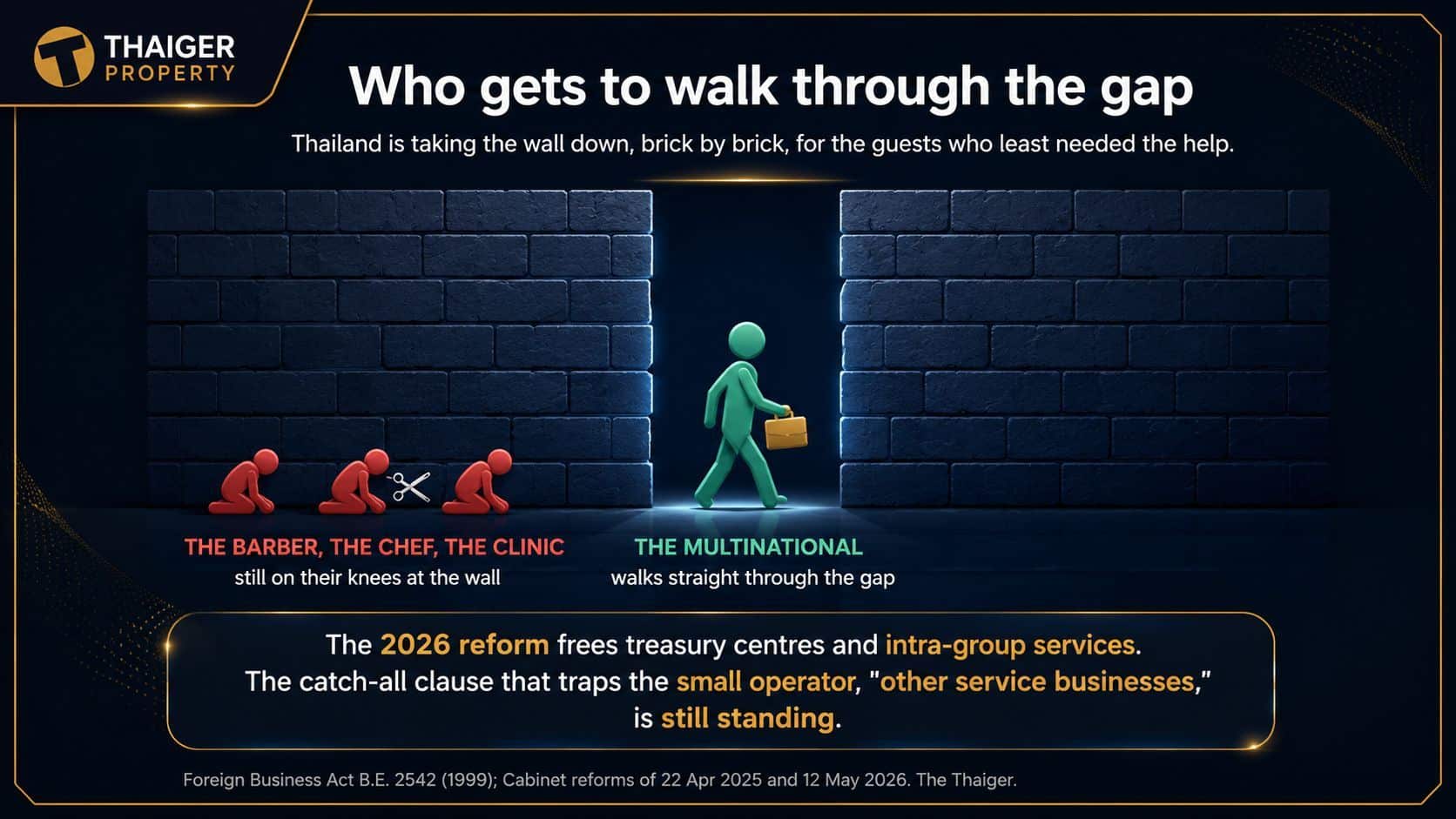
So picture her one more time, sweeping up at the end of the day in a shop the law still says he should not really own, one of ten thousand small foreign businesses that helped make Thailand the place the whole region envies. Thailand has admitted, in writing, that the wall he was made to climb was built too high, and it is taking that wall down, brick by brick, for its biggest and least vulnerable guests. He is still on his knees in front of it, scissors in hand, harming no one, having helped build the very appeal everyone else is now cashing in on. Thailand has finally learned the lesson. It has just decided who gets to walk through the gap, and the barber is not on the list.
https://thethaiger.com/wp-content/uploads/2026/06/01a4e273-f3d3-48bf-8aa3-6f1c97cc3b1c.jpg
Tell us where you land.
[SERIES NOTE] This is part six of The Thaiger’s ten-part series on Thailand’s property market and the wider question of how the country handles foreign capit[...]
← Back to newsThai lawyers have put this more bluntly than we would dare. One senior partner noted that there has always been a fast, simple fix, the government can exempt service categories by ministerial regulation with a stroke of the pen, and added, on the record, that “the Thai government simply does not want to.” Others warn that past FBA reforms have a habit of lifting a restriction in one place only for another regulator to quietly reimpose it in another, leaving the foreigner exactly as boxed in as before, just by a different department. The scope of restricted activities, in the words of one Thai corporate counsel, remains vague, still exposing people to retrospective scrutiny and shifting interpretation. The gap between the rule on paper and the rule in practice, the thread running through this whole series, runs straight through the business story too. The same lesson, refusing to be learned twice
The parallel with property is almost exact. In property, Thailand tore down the legal route to ownership and left the nominee workaround standing, then started prosecuting the people who used it. In business, Thailand built a restriction that made the nominee workaround near-unavoidable for small operators, and is only now, partially, and only for the largest players, beginning to take it apart. Both run on the same broken machine: a rule so blunt it forces honest people into a grey structure, and a state that then treats the grey structure, rather than its own rule, as the crime.
And both point to the same fix, the one this series keeps circling and will land on at its end. You do not hunt the workaround into extinction with raids. You build a clean, legal road beside it, so clear and so durable that no sane person takes the dangerous detour anymore, and the grey structures empty out on their own, without a single prosecution. The business reform is, at last, a half-step onto exactly that road. It is the proof that Thailand understands the principle perfectly: lower the barrier, and the evasion you hated vanishes by itself. It has simply chosen to hand that understanding to the multinational with the treasury centre, and not yet to the designer with her studio, or the clinic, or the café, the people who quietly helped make the country worth moving to.
So picture her one more time, sweeping up at the end of the day in a shop the law still says he should not really own, one of ten thousand small foreign businesses that helped make Thailand the place the whole region envies. Thailand has admitted, in writing, that the wall he was made to climb was built too high, and it is taking that wall down, brick by brick, for its biggest and least vulnerable guests. He is still on his knees in front of it, scissors in hand, harming no one, having helped build the very appeal everyone else is now cashing in on. Thailand has finally learned the lesson. It has just decided who gets to walk through the gap, and the barber is not on the list.
https://thethaiger.com/wp-content/uploads/2026/06/01a4e273-f3d3-48bf-8aa3-6f1c97cc3b1c.jpg
Tell us where you land.
[SERIES NOTE] This is part six of The Thaiger’s ten-part series on Thailand’s property market and the wider question of how the country handles foreign capit[...]