Source @thailand_news
Let us be scrupulously clear, because this is sensitive ground and it deserves precision rather than heat.
nd a state that tolerates something for twenty years, profits from it, registers each instance of it, and stamps every transfer, has made itself a party to the arrangement. To then pivot and prosecute the end user, while the officials who waved it through keep their pensions and the firms that sold it keep their fees and their offices, is not the impartial application of a timeless rule. It is a choice about who pays the bill for a collective, two-decade understanding. And the bill has been handed, with remarkable precision, to the person with the least power, the least knowledge, and the weakest voice in the room. What this argument is, and what it is not
Let us be scrupulously clear, because this is sensitive ground and it deserves precision rather than heat.
This is not a claim that Thailand has no right to enforce its land laws. It has every right, completely and without qualification. A country is entitled to decide who owns its land, and to change its mind about how strictly to police that. This is not a defence of the genuine fraudsters either, the organised operators running restricted businesses entirely behind borrowed names, the industrial-scale nominee networks, the people laundering money through villa companies. They have earned everything coming to them, and more. And this is emphatically not a claim that Thailand is uniquely corrupt, or that its institutions are a scam. They are not. Every country on earth has gaps between the law as written and the law as practised, and every country eventually faces a reckoning when it decides to close one. There is nothing especially Thai about that. It is simply human.
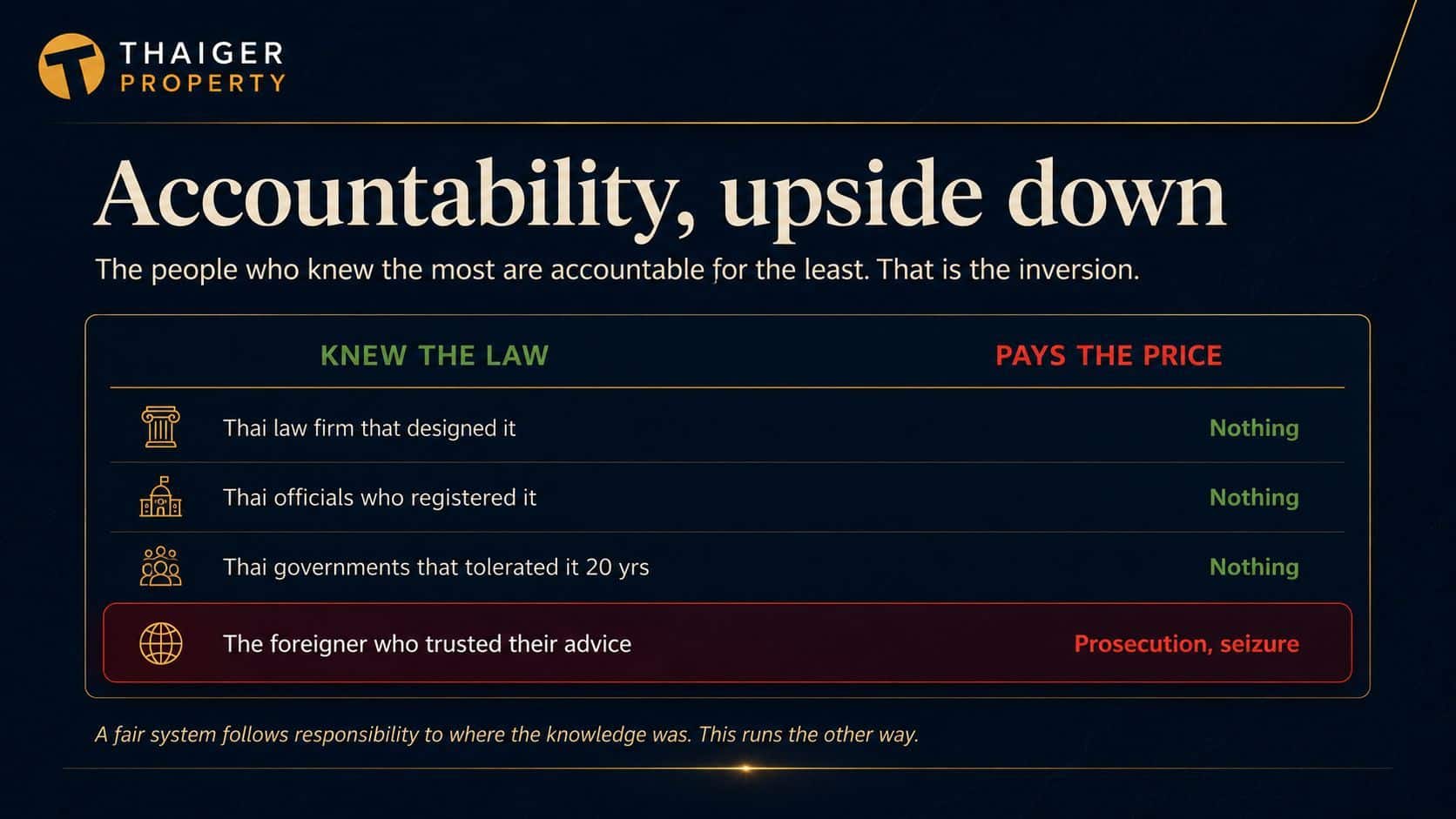
The point is narrower, and harder to wave away. If you are going to enforce a law that was broken by a long chain of people, then basic fairness asks that you follow the chain. And this chain runs overwhelmingly through knowledgeable, professional, licensed, official hands, the people whose entire function was to understand the law and apply it correctly. The foreign buyer sits at the very end of that chain as its least informed link, the one who relied on expert advice rather than gave it. A system that pursues him first, and hardest, while the architects of the scheme face no consequence at all, has turned the natural order of responsibility upside down. The people who knew the most are being held accountable for the least. The person who knew the least is being held accountable for everything.
https://thethaiger.com/wp-content/uploads/2026/06/2d93682d-b516-4541-b9d2-d9b72560d9c7.jpg
You cannot, in good conscience, tell a man to “just follow the law” when a licensed professional, whose whole job was to know that law, looked him in the eye and told him in writing that he was following it. Ignorance of the law is no defence; that principle is sound and old and we do not dispute it. But reliance on the considered, documented, paid advice of the country’s own legal professionals is a different thing entirely, morally if not always legally, and a fair system recognises the difference. There is a world of distance between the person who set out to cheat and the person who paid good money to be told he was not cheating. What following the chain would actually look like
None of this is an argument for letting anyone off. It is an argument for matching accountability to knowledge, and there is a constructive, entirely achievable version of it that would make this crackdown look like justice rather than a shakedown of the easiest targets.
Start the enforcement where the knowledge was. A licensed law firm that designed and sold an unlawful structure as lawful, for two decades, for a fee, bears a professional responsibility that the client who trusted it simply does not. If these structures were illegal all along, and the authorities are adamant that they were, then the professionals who built and marketed them are the obvious and logical place for serious enforcement to begin. That is not foreigner-protection. It is professional ac[...]
← Back to newsLet us be scrupulously clear, because this is sensitive ground and it deserves precision rather than heat.
This is not a claim that Thailand has no right to enforce its land laws. It has every right, completely and without qualification. A country is entitled to decide who owns its land, and to change its mind about how strictly to police that. This is not a defence of the genuine fraudsters either, the organised operators running restricted businesses entirely behind borrowed names, the industrial-scale nominee networks, the people laundering money through villa companies. They have earned everything coming to them, and more. And this is emphatically not a claim that Thailand is uniquely corrupt, or that its institutions are a scam. They are not. Every country on earth has gaps between the law as written and the law as practised, and every country eventually faces a reckoning when it decides to close one. There is nothing especially Thai about that. It is simply human.
The point is narrower, and harder to wave away. If you are going to enforce a law that was broken by a long chain of people, then basic fairness asks that you follow the chain. And this chain runs overwhelmingly through knowledgeable, professional, licensed, official hands, the people whose entire function was to understand the law and apply it correctly. The foreign buyer sits at the very end of that chain as its least informed link, the one who relied on expert advice rather than gave it. A system that pursues him first, and hardest, while the architects of the scheme face no consequence at all, has turned the natural order of responsibility upside down. The people who knew the most are being held accountable for the least. The person who knew the least is being held accountable for everything.
https://thethaiger.com/wp-content/uploads/2026/06/2d93682d-b516-4541-b9d2-d9b72560d9c7.jpg
You cannot, in good conscience, tell a man to “just follow the law” when a licensed professional, whose whole job was to know that law, looked him in the eye and told him in writing that he was following it. Ignorance of the law is no defence; that principle is sound and old and we do not dispute it. But reliance on the considered, documented, paid advice of the country’s own legal professionals is a different thing entirely, morally if not always legally, and a fair system recognises the difference. There is a world of distance between the person who set out to cheat and the person who paid good money to be told he was not cheating. What following the chain would actually look like
None of this is an argument for letting anyone off. It is an argument for matching accountability to knowledge, and there is a constructive, entirely achievable version of it that would make this crackdown look like justice rather than a shakedown of the easiest targets.
Start the enforcement where the knowledge was. A licensed law firm that designed and sold an unlawful structure as lawful, for two decades, for a fee, bears a professional responsibility that the client who trusted it simply does not. If these structures were illegal all along, and the authorities are adamant that they were, then the professionals who built and marketed them are the obvious and logical place for serious enforcement to begin. That is not foreigner-protection. It is professional ac[...]