Source @thailand_news
Here is the part that sits most awkwardly with the official story. None of this was a secret kept from the authorities. The authorities processed it.
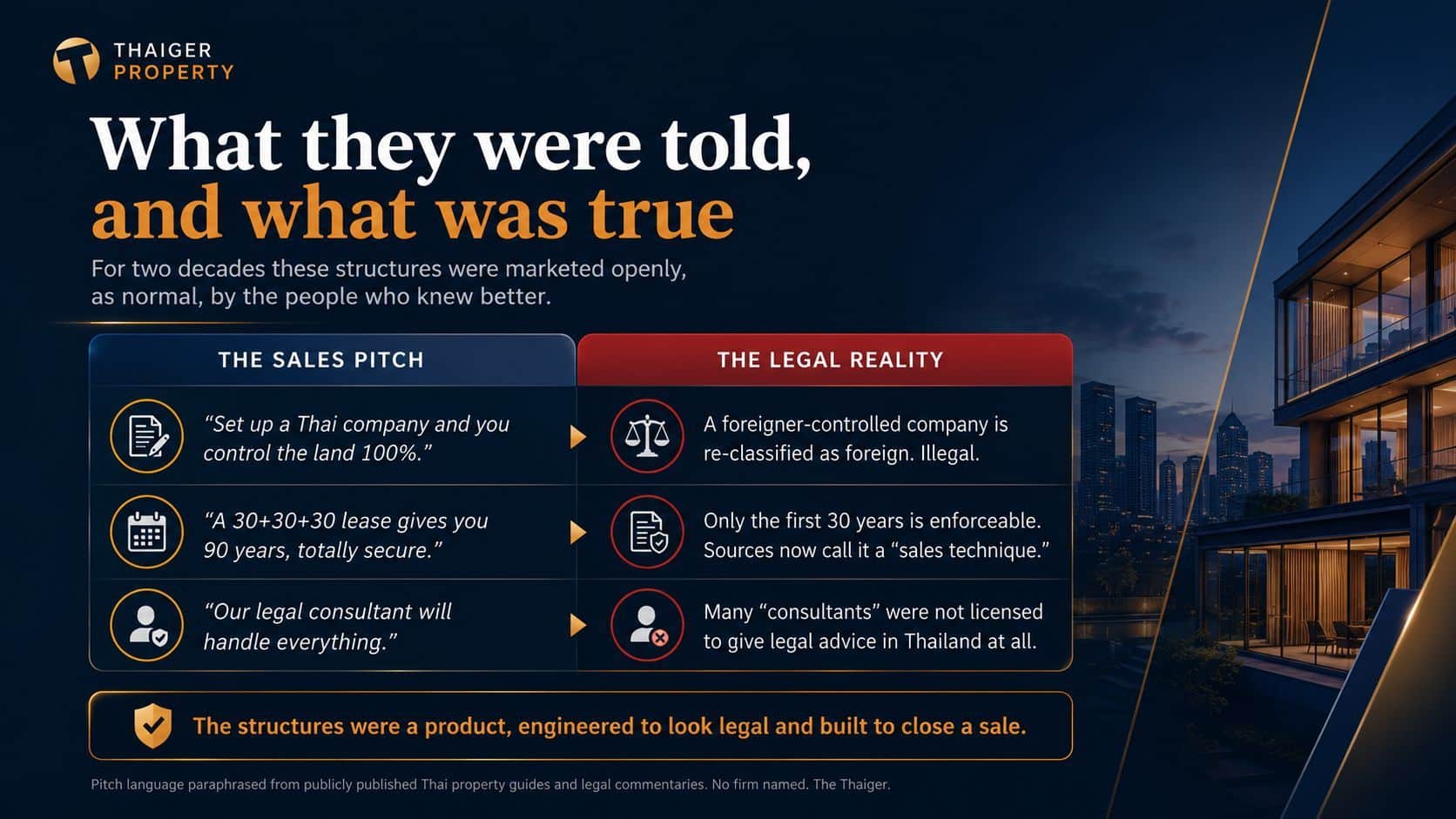
because it is the whole argument in a sentence, and it comes from within the Thai legal community itself, not from an aggrieved foreigner. The structures were not a grey area that buyers stumbled into. They were a product, engineered and sold, with the paperwork deliberately dressed to look legitimate.
It went further than the lawyers, too. Many of the “legal consultants” who were the first and only point of contact for foreign buyers, the ones who spoke their language, explained the company structure, and presented themselves as trusted advisers, were not permitted to give legal advice in Thailand at all. Their work permits, by several accounts, listed them as “consultants” or “office managers,” not lawyers. So a foreign buyer was frequently reassured about the legality of his purchase by someone who was not legally a lawyer, working inside a firm whose business model depended on closing the sale, using a structure the firm knew a court would not uphold. And the famous fallback, the “30+30+30 year lease” sold to thousands as nine decades of security, is described by industry sources today, with no apparent embarrassment, as “a sales technique, not a legal guarantee.” Others call it, more plainly, a widespread legal fabrication.
https://thethaiger.com/wp-content/uploads/2026/06/92a58156-8ca5-4abd-8238-9768ea57883d.jpg
You can still find the mechanics laid out, calmly and without alarm, in mainstream property guides published right up to this year: the company structure, the share split, the lease arrangement, presented for years as simply how a foreigner buys a villa here. None of it was hidden. All of it was normal. That was precisely the point. A foreigner could not have built one of these structures alone if he tried. It required Thai shareholders, Thai company registration, Thai notarisation, and Thai officials at every step. It was, from start to finish, a domestic industry serving foreign demand, and profiting handsomely from it.
One of our own readers, who had been through it, described being advised three years ago by a “very famous law firm” that a nominee company with layered share classes was a sound and lawful way to hold property. He counts himself lucky the deal fell through. He is not unusual. He is typical. An entire generation of foreign buyers did exactly what the most respectable-looking professionals in the country told them was fine. The advice was wrong, or dishonest, or both. But it was advice, given by paid experts, for a fee, inside Thailand. The state was not a bystander. It was a participant.
Here is the part that sits most awkwardly with the official story. None of this was a secret kept from the authorities. The authorities processed it.
Every nominee company is registered with the Department of Business Development. Every land transfer is recorded at a land office. The structures were visible, on the public record, sitting in government databases, for anyone in officialdom who cared to look, and for twenty years, across administration after administration, elected and unelected alike, nobody chose to look hard. Not because the structures were cleverly hidden, they were not, but because the foreign money was useful. It built the condos. It filled the resorts. It propped up the construction industry through every downturn. It underwrote hundreds of thousands of Thai jobs in precisely the tourist provinces that had little else. The nominee company was the quiet pipe through which a great deal of that capital flowed into the country, and successive governments left the pipe open because the whole economy was drinking from it.
You cannot run a thing for two decades, tax it, register it, stamp it, build your beach economy on top of it, and then declare it a crime the moment the politics shift, and pretend you only just noticed it was there. A law left unenforced for twenty years is not really a law. It is a policy of tolerance, an unwritten arrangement that everyone, including the state, understood and benefited from.
A[...]
← Back to newsIt went further than the lawyers, too. Many of the “legal consultants” who were the first and only point of contact for foreign buyers, the ones who spoke their language, explained the company structure, and presented themselves as trusted advisers, were not permitted to give legal advice in Thailand at all. Their work permits, by several accounts, listed them as “consultants” or “office managers,” not lawyers. So a foreign buyer was frequently reassured about the legality of his purchase by someone who was not legally a lawyer, working inside a firm whose business model depended on closing the sale, using a structure the firm knew a court would not uphold. And the famous fallback, the “30+30+30 year lease” sold to thousands as nine decades of security, is described by industry sources today, with no apparent embarrassment, as “a sales technique, not a legal guarantee.” Others call it, more plainly, a widespread legal fabrication.
https://thethaiger.com/wp-content/uploads/2026/06/92a58156-8ca5-4abd-8238-9768ea57883d.jpg
You can still find the mechanics laid out, calmly and without alarm, in mainstream property guides published right up to this year: the company structure, the share split, the lease arrangement, presented for years as simply how a foreigner buys a villa here. None of it was hidden. All of it was normal. That was precisely the point. A foreigner could not have built one of these structures alone if he tried. It required Thai shareholders, Thai company registration, Thai notarisation, and Thai officials at every step. It was, from start to finish, a domestic industry serving foreign demand, and profiting handsomely from it.
One of our own readers, who had been through it, described being advised three years ago by a “very famous law firm” that a nominee company with layered share classes was a sound and lawful way to hold property. He counts himself lucky the deal fell through. He is not unusual. He is typical. An entire generation of foreign buyers did exactly what the most respectable-looking professionals in the country told them was fine. The advice was wrong, or dishonest, or both. But it was advice, given by paid experts, for a fee, inside Thailand. The state was not a bystander. It was a participant.
Here is the part that sits most awkwardly with the official story. None of this was a secret kept from the authorities. The authorities processed it.
Every nominee company is registered with the Department of Business Development. Every land transfer is recorded at a land office. The structures were visible, on the public record, sitting in government databases, for anyone in officialdom who cared to look, and for twenty years, across administration after administration, elected and unelected alike, nobody chose to look hard. Not because the structures were cleverly hidden, they were not, but because the foreign money was useful. It built the condos. It filled the resorts. It propped up the construction industry through every downturn. It underwrote hundreds of thousands of Thai jobs in precisely the tourist provinces that had little else. The nominee company was the quiet pipe through which a great deal of that capital flowed into the country, and successive governments left the pipe open because the whole economy was drinking from it.
You cannot run a thing for two decades, tax it, register it, stamp it, build your beach economy on top of it, and then declare it a crime the moment the politics shift, and pretend you only just noticed it was there. A law left unenforced for twenty years is not really a law. It is a policy of tolerance, an unwritten arrangement that everyone, including the state, understood and benefited from.
A[...]